
Bow, Shake or Kiss
Objective
- Practice greeting rituals.
Instructions
- Clear a large area free of chairs and desks. Participants will need room to walk about and move.
- Gather participants in a circle.
- Ask students to start walking randomly and silently in the open space. Explain the purpose is not to walk to a destination, but just to walk around while keeping a comfortable distance from others.
- After the participants have settled into walking in space, ask them to start making eye contact with those they pass.
- After participants have settled into walking and making eye contact, ask them to approach each other for a handshake. Once they have completed the handshake, they should continue to walk in space then find another handshake partner. This is all done in silence.
- While participants are walking in space and shaking hands, ask reflective questions.
- What is the proper amount of pressure to create with your hands?
- Where does the webbing between your finger and thumb connect with the other hand?
- How long does a handshake last?
- Is there a perfect handshake?
- Is there a confident handshake? A weak one?
- Can you judge someone’s character on a handshake? Confident? Dishonest? Domineering? Warm?
Debriefing
- How did it go?
- What did you notice about an activity you have done thousands of times before?
- What did you notice about your own handshake?
- Did you notice any judgments about yourself or others?
- Did you realize any values imbued within the handshake?
Take Away
- Greeting rituals carry enormous relational weight.
- Greeting rituals can reveal, submissive, warm, distant, and various other positions.
- Participants may have increased mindfulness of their greeting rituals. This increased mindfulness is an excellent place from which to discuss a new cultures’ greeting ritual.
Analogous Contextualization
Objective
- Develop the skill of using analogies to explain cultural difference
Instructions
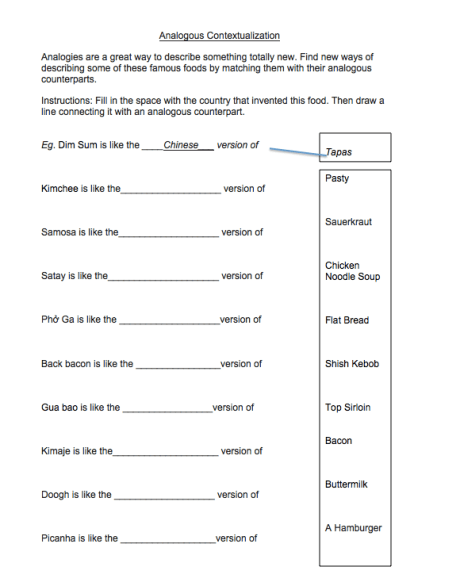
- Pass out Analogous Contextualization worksheet.
- Allow 5 minutes for participants to complete the sheet.
- Indicate that full title of the worksheet is a clue.
- Ask the group to shout out the answers by saying, “ Dim Sum is like the……version of……”
- If a participant indicates an incorrect or disputed answer, acknowledge that several countries may claim a particular dish.
- Distribute ANSWER KEY.
Notes
- Taiwan is understood as both a country and as a province of China.
- Currently it is unclear whether the satay originated from Indonesia or Malaysia.
Debriefing
- Which ones were easy to guess? Why were they easy?
- Is kimchee sauerkraut? What is the limitation of an analogy?
- Will you have students who are familiar with one of these foods?
- Have you ever sought foreign food in your home culture?
- Who has had experience seeking a familiar food while in a foreign culture?
- Among your friends, would you invite someone to eat Phở or Vietnamese soup? Why the difference?
The Printed Handout


0 Comments